Heat exchangers are used to transfer heat between fluids with different temperatures. Industries use them for heating, cooling and temperature control. The types of heat exchangers available today differ in design and operation. Choosing the right type depends on the process and the working conditions.
A heat exchanger is equipment that transfers thermal energy from one fluid to another. The fluids usually move through separate passages. A heat transfer surface allows energy to move from the hotter fluid to the colder fluid. Different designs are available because industrial processes have different temperature, pressure and flow requirements.
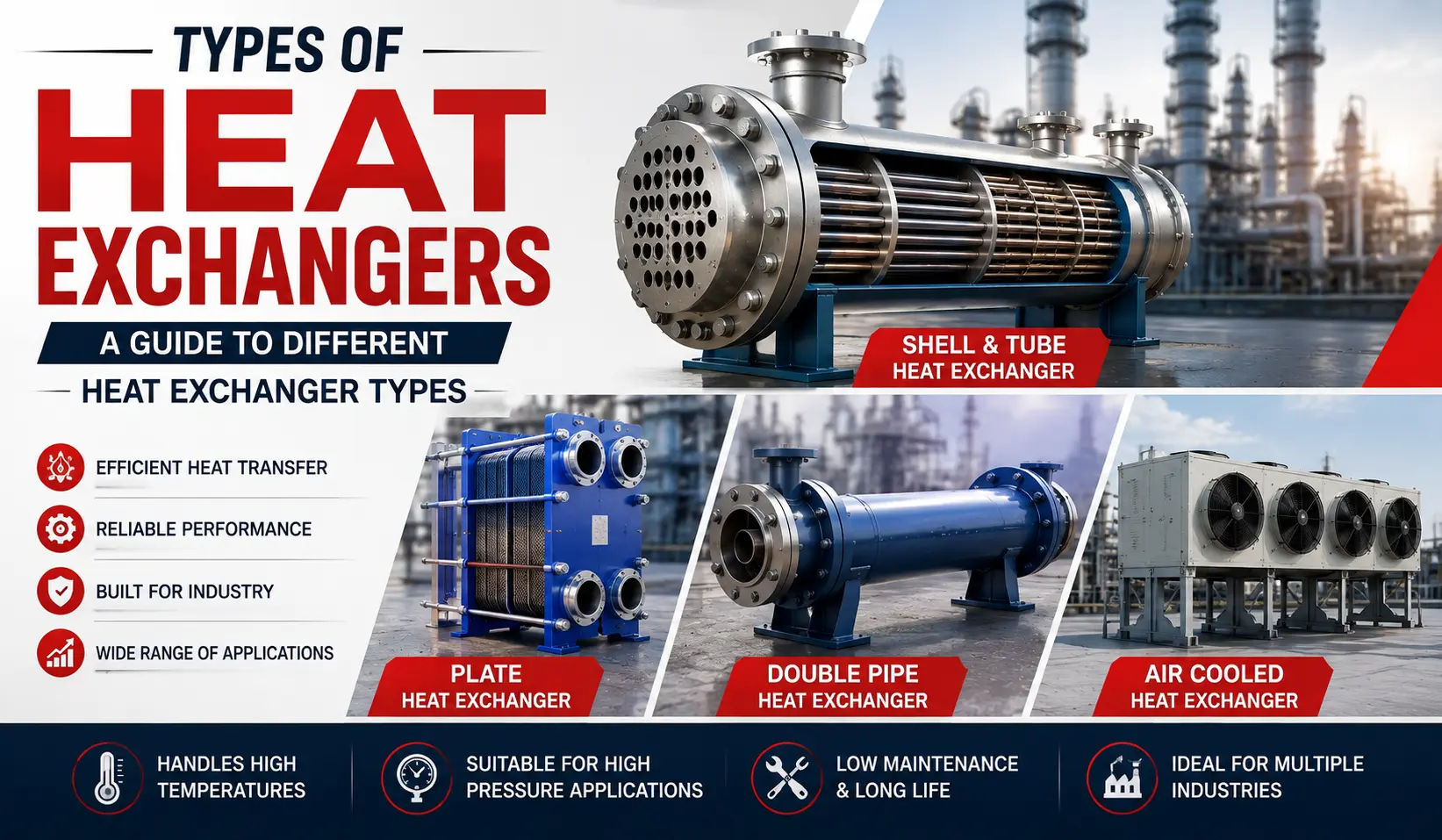
The most suitable heat exchanger depends on the application. Some designs are built for high-pressure processes while others focus on compact construction or easier maintenance. They are selected based on process needs and operating conditions.
Material selection also plays an important role in performance. Proper design improves efficiency and reduces energy loss.
A shell and tube heat exchanger has tubes placed inside a larger shell. One fluid flows through the tubes while another moves around them. This design is widely used in chemical processing and power generation. It is also suitable for demanding industrial conditions. It offers good durability for long term use. Also maintenance is relatively easy due to removable tube bundles.
A plate heat exchanger uses a series of thin plates to create separate flow channels. Heat moves through the plates between the fluids. Its compact structure makes it useful for HVAC systems and many process applications. It provides high heat transfer efficiency in a small space. It is easy to clean and maintain in most applications. Also it is suitable for low to medium pressure systems.
A double pipe heat exchanger uses one pipe inside another. The two fluids flow through separate passages. Its simple construction makes it suitable for smaller heating and cooling duties. It is cost effective for small scale operations. It is easy to install and operate. That's why it is often used for simple heat transfer tasks.
An air-cooled heat exchanger uses air to remove heat from a process fluid. It can be useful where cooling water is limited. These systems are commonly used for industrial fluid cooling. It reduces dependency on water resources.
| Heat Exchanger Type | Main Feature | Common Application |
|---|---|---|
| Shell and Tube | Strong industrial design | Process industries |
| Plate | Compact construction | HVAC and processing |
| Double Pipe | Simple design | Smaller duties |
| Air Cooled | Uses air for cooling | Industrial cooling |
The right heat exchanger should match the actual process requirements. Temperature and pressure can affect equipment selection. Fluid properties and flow rate also need attention. Maintenance requirements and available installation space should be considered before final selection. Working with an experienced heat exchanger manufacturer in Mumbai can help businesses identify a suitable design.
The types of heat exchangers available today serve different industrial needs. Shell and tube units suit demanding applications while plate designs offer compact heat transfer. Double pipe and air-cooled systems serve other specific requirements. Selecting equipment based on actual process conditions helps achieve reliable and consistent heat transfer.